Ask Google how local search works and you'll get the same three-word answer they've published since 2017: relevance, distance, prominence. It's on their help docs and it's what their support reps say. It's also wildly incomplete.
Real ranking depends on at least six other signals Google won't talk about publicly. Some come from patent filings, some from years of split-testing across the local SEO community, some from watching what moves the heatmap when nothing else changed. We track them across our clients and the pattern holds in 2026.
Here are the six, ordered by how much they actually matter.
What Google says publicly
- Relevance
- Distance
- Prominence
What actually moves rank
- Review velocity (not total)
- Reply density & distinctiveness
- Photo additions over time
- Service-area heatmap shape
- Click-through behaviour
- Q&A and messaging activity
1. Review velocity (not total review count)
Most owners think the magic number is total reviews. The actual number Google watches is how fast you're adding them, compared to the businesses around you and your own past pace.
A business going from 5 reviews per month to 12 reviews per month sends a stronger signal than a business sitting steady at 30 per month. Acceleration matters more than absolute volume, because it proves to Google's system that something has changed about the business that's worth indexing fresh.
This is also why old established businesses sometimes lose 3-pack positions to new ones in the same area. The new business is accelerating; the established one has flat-lined. The signal isn't "who has more reviews", it's "who's growing faster".
The simple rule
Change matters more than total. A growing business out-ranks a bigger but flat one in nearly every category we audit.
2. Reply density (almost no one talks about this)
Owner replies are a ranking signal. We mean two specific things by that:
- Reply rate: what percentage of your reviews you respond to. Businesses that reply to 80% or more of reviews consistently out-rank otherwise-identical businesses that reply to 40%.
- Reply distinctiveness: how different each reply is from the others. Templated "thanks for the great review" copy-pastes get heavily discounted. Replies that reference specific details from the original review carry full weight.
We covered the reply problem in detail in this piece. The short version: the algorithm reads variation as engagement. Sameness reads as a script.
3. Photo additions (yours and reviewers')
Google rewards profiles with regular photo activity. Both photos you upload as the business owner and photos uploaded by reviewers with their reviews count.
The benchmark we see in the top 3-pack: at least 3 to 5 new photos per month, mixed between owner uploads and customer uploads. Most small businesses we audit go months without adding a single one. That's a free ranking signal being left on the table.
Photos with EXIF data (geo-tagged, taken on a real phone, not downloaded from a stock site) carry more weight. Google can tell the difference. A photo with no metadata is treated as a stock image even if it isn't.
4. Service-area engagement (heatmap shape)
Google ranks you differently from every geographic point in your service area. A pin in the centre of your suburb might show you at position #2; a pin a kilometre away might show #6; a pin three kilometres away might show #18 or not at all.
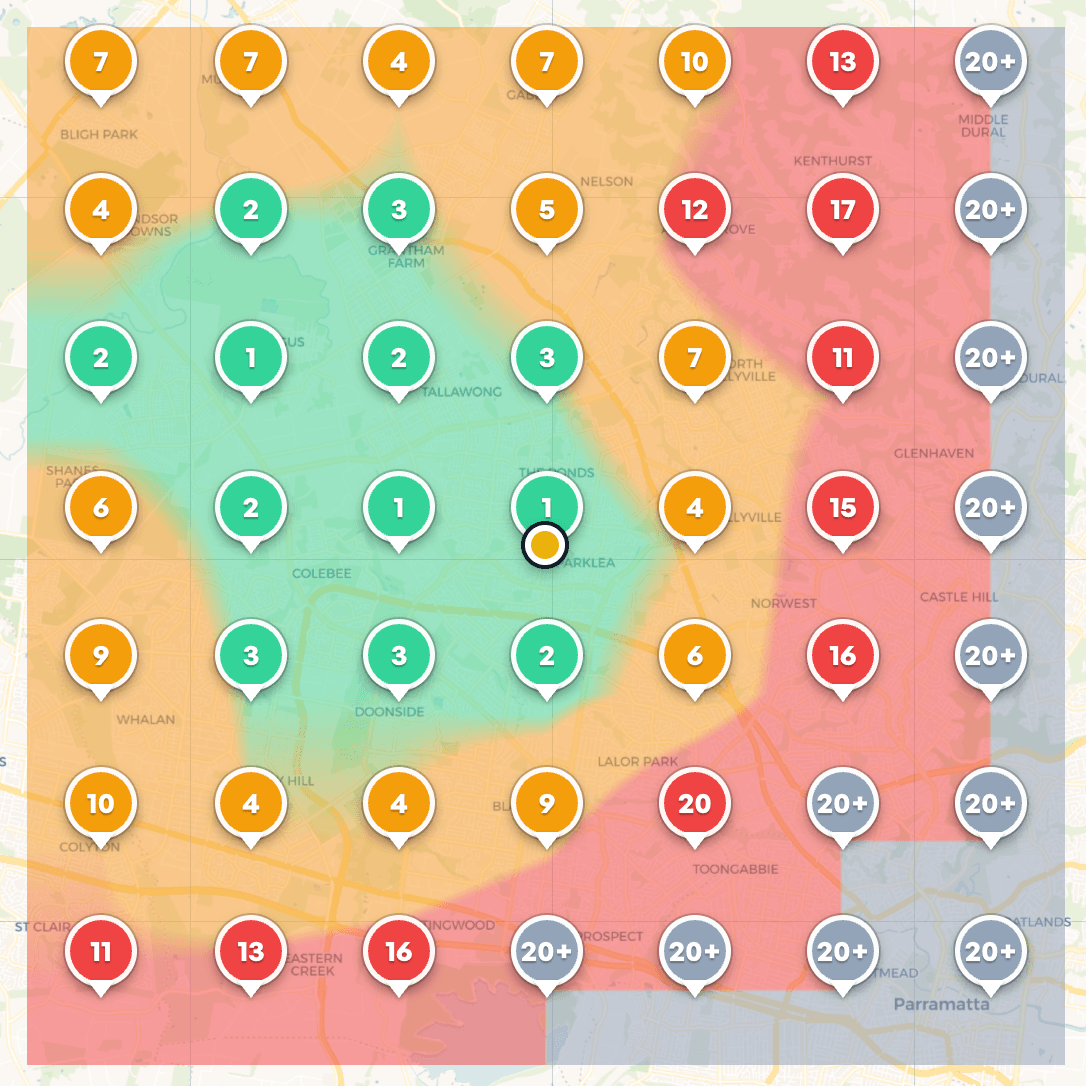
The shape of that heatmap is itself a signal. Google reads "this business gets called from a wide radius" as a prominence signal. Businesses whose ranking heatmap covers a big green area win in two ways: they appear in more searches, and Google trusts them more in nearby searches as a result.
The lever you can pull here is asking customers from across your service area for reviews and replies, not just the customers nearest your front door. A bond clean review from a customer 8km away is more useful for your rank in their suburb than another review from a customer next door.
5. Click-through behaviour from search results
When someone sees your business in a search and clicks the result, Google notices. When they click through to your website, ask for directions, or call from your profile, Google notices that too. These are click-through behaviours, and they feed back into your rank.
The signal is "people who saw this business actually clicked on it". The way to influence this isn't trickery, it's making your profile snippet earn the click:
- Photo as the lead: the photo that appears next to your business name in search is the first thing prospects see. A great primary photo lifts CTR significantly.
- Star rating + review count visible: 4.8 (152) out-clicks 4.9 (8) almost every time, despite the lower rating. Volume signals trust.
- Hours of operation listed: profiles that show "Open · closes 6pm" get more clicks than ones that say "Hours not listed". Add holiday hours too.
6. Q&A and message activity
The Questions section on a Google profile (where customers ask public questions and the owner can answer) used to be a major ranking signal. Google quietly retired the public Q&A feature in many regions in 2025. What replaced it as a signal: messaging activity, including how fast the business responds and how often customers initiate chats.
Owners who turn on Google Business Profile messaging and respond within an hour see incremental ranking lifts. The signal is engagement responsiveness, not just message volume.
What this means for what you should do
You don't need to do all six perfectly. Most businesses that reach the 3-pack do four of them well and let two slide. Pick the ones that fit your operation:
- You can ask every customer → fix review velocity first. Use a single channel (SMS works best), ask within 24 hours of the service.
- You have a team that interacts with customers → fix reply density next. Reply to everything in your voice within a day.
- You take photos of your work anyway → upload them to your Google profile every week. Even three a week makes a difference over a quarter.
- You serve a wide area → ask reviews from customers across that area, not just the ones nearest you. Track which suburbs your reviewers come from.
If you want to know where you currently rank across your service area before doing any of this, that's the heatmap we generate as part of the strategy call. It'll tell you which of these six signals is actually your bottleneck.
None of these require special software. They require a system that runs every week without dropping. That's the entire game.